

Many of my clients come to me feeling a profound sense of confusion.
They are often high-functioning individuals who appear to be doing "well" on the outside. Yet, they are plagued by a relentless inner critic. They find themselves struggling with self doubt, dependent on achievements or validation from others for self-worth, paralyzed by simple decisions, or feeling an exhausting need to be perfect.
They look at their lives and think, "I don’t have a right to struggle like this. My parents provided for me. I grew up in a safe neighborhood. We went on vacations every year. I had everything I wanted and needed. Nothing 'bad' really happened." Because they can’t find a "reason" for their pain, they turn that frustration inward, assuming the problem is just them.
Many of the clients I see come from families where they were materially provided for, given their basic needs and then some in the form of material comforts and some general form of support. It is possible that you came from a supportive house in some aspects, that failed you in others. It is harder to catch things while you’re “in it.”
Think of a goldfish in a tank. That tank is its entire universe. It doesn't know the water is cloudy, or that the glass is cracked, or that there’s a whole ocean with a different current elsewhere. To the goldfish, the tank isn't "good" or "bad"—it’s “normal,” the only reality it has ever known.
Relational trauma works the same way. When you grow up in a household where your emotions were ignored, where your reality was invalidated, or where you had to be "perfect" to be loved, you don't call it trauma. You call it "Tuesday." You assume every other house works this way, so you turn the frustration inward.
The truth is that we aren’t born with shame, pressure, doubt, or indecision. We aren’t born believing we are "too much" or "not enough" (both of which you can experience at the same time). We become who we are as a response to our environment.
Our surroundings shape us profoundly—the tone in which we were spoken to, the way our emotions were met (or dismissed), and the freedom we were given to make our own choices and mistakes. You aren't "broken"; you are a reflection of the environment you swam in.
Acknowledging your trauma isn't about blaming your past—
it’s about understanding why you are the way you are.
The Trauma Spectrum: Big ‘T’ vs. Little ‘t’
To many, the word "Trauma" feels like a title you have to earn through extreme catastrophe. We tend to rank our pain, telling ourselves that unless we experienced a "Big T" event, our struggle isn't valid. But your nervous system doesn't rank trauma; it simply records the absence of safety.
Big T Trauma (The Loud)
These are the events that most people recognize as "traumatic." They are typically life-threatening or deeply distressing singular events that overwhelm your ability to cope. There is a clear "before" and "after."
little t trauma (The Quiet)
This is where Relational Trauma and Complex PTSD (C-PTSD) live. These are events that may not be "life-threatening" in the moment but are "life-altering" in their repetition. They are the subtle, everyday occurrences that erode your sense of security. Because they are often "normalized," they are the hardest to name.
Unlike standard PTSD, C-PTSD is the result of prolonged, repeated trauma within a relationship where you couldn't escape—like your family of origin. Because these "little t" moments (emotional volatility, neglect, invalidation) happen day after day, your nervous system stays in a state of "permanent alarm."
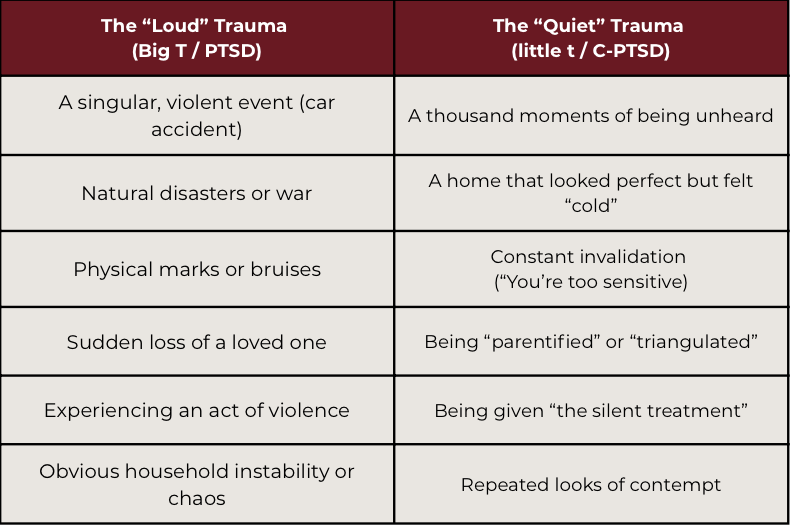
Trauma: Big T vs. little t. What’s the difference?
How would I know if I experienced Relational Trauma?
Because relational trauma is often subtle and "normalized," it’s hard to see unless you know what to look for. You might have experienced relational trauma if your upbringing included:
Constant Criticism: A household where mistakes were met with berating rather than teaching.
Disabling Expectations: Constant pressure to excel that made you feel like you were perpetually performing rather than just existing.
Conditional Affection: Feeling like love was a reward for being "good," "quiet," or "successful" rather than a birthright.
Invalidation: Being told your feelings were "wrong," that you were "too sensitive," or that your memory of an event "never happened."
Rejecting & Ignoring: Communicating abandonment through a refusal to communicate and show affection; using the “silent treatment” as a form of discipline or disapproval.
Symbolic Intimidation: A household atmosphere defined by a "sneer," looks of disgust, or a tone of voice that communicates absolute rejection. This includes "acting" like they want to hurt you or using aggressive body language to force compliance.
Negative Comparison: You were constantly compared to siblings, cousins, or peers ("Why can’t you be more like Tommy?"). This teaches a child that their value is relative and they are perpetually "deficient."
Triangulation: Being put in the middle of your parents' conflict. Acting as the messenger, the peacemaker, or the "buffer" between them.
Parentification: Finding yourself acting as the emotional anchor, therapist, or confidant for your parent, or taking on responsibilities that belong to your parent (e.g. taking care of the other children in the house, or taking on more of the household responsibilities than were appropriate for your age.)
How would I know if I experienced C-PTSD?
While not yet a standalone diagnosis in the DSM-5, Complex Trauma refers to exposure to multiple traumatic events that are often interpersonal and occur during key developmental stages. When relational trauma goes unaddressed, it often develops into C-PTSD.
Its markers often feel like personality traits, but they are actually adaptations. It impacts your very sense of self. It’s not just about what happened; it’s about how you see the world and your own worth.
Toxic Shame: A persistent, global feeling that you are fundamentally flawed, regardless of your achievements.
A Harsh Inner Critic: A relentless internal voice that demeans, mocks, or pressures you.
Emotional Flashbacks: Suddenly feeling the same intense shame or panic you felt as a child, often triggered by a minor mistake or a perceived slight.
The "Fawn" Response: Your knee-jerk reaction to conflict is to appease, "fix," or over-explain to keep the peace at the expense of your own needs.
Hyper-Vigilance: You are an expert at reading the "vibe" of a room. You notice a tightened jaw or a heavy sigh instantly, staying on high alert to predict someone else’s mood.
Chronic Self-Watching: You constantly "grade" your performance in real-time, watching yourself speak and act as if you are waiting for a mistake.
Decision Paralysis: Since making a mistake felt dangerous in your childhood tank, making a simple choice now feels life-threatening.
When Material Stability Masks Emotional Pain
The reason relational trauma is so hard to detect is that it becomes the air you breathe. If you grew up in a home where your parents were physically present but emotionally absent, you don't call it "trauma." You call it "home."
If you grew up in a neighborhood where community violence or systemic stress was a constant background noise, you don't call it "chronic stress." You call it "normal."
But your nervous system knows. It doesn't need a "Capital T" event to feel shattered. It only needs to feel consistently unseen, unheard, or unprotected.
Neglect: The Trauma of What Didn't Happen
Emotional neglect is perhaps the most common form of relational trauma because it is an act of omission. It is what didn't happen.
It’s the parent who didn't ask how you were feeling after you were bullied.
It’s the family that "doesn't talk about" difficult things.
It’s the sense that you were only loved for your achievements (the "A" on the report card) rather than your inherent self.
It’s the caregiver who was physically present but never made the effort to get to know you or understand your thoughts, opinions, and interests.
It’s the lack of guidance that forced you to become your own parent before you were even a teenager.
When a child’s emotional reality is consistently ignored or minimized, they learn that their feelings are irrelevant.
Emotional Abuse: The Trauma of Atmosphere
While physical abuse leaves marks, emotional abuse uses language and behavior to control, intimidate, or diminish you.
It’s the critical reaction, like calling you “stupid” for making a simple mistake.
It’s the direct comparison, asking things like “why can’t you act more like your brother?” that ingrained the idea that you are less than others.
It’s the "sneer" or the look of contempt that communicated you were disgusting or offensive without a single word being said.
It’s being called "too sensitive" when you expressed a legitimate hurt, making you feel that you were the problem.
It’s the parent who prioritized their feelings and comfort over yours, focusing on how your behavior “affects the family,” rather than helping you regulate your emotions.
It’s the public humiliation of being berated in front of family, neighbors, or peers to "teach you a lesson."
It’s the parent who used "the silent treatment" for days to punish you, making the home feel like a frozen wasteland.
Unpredictability: The Trauma of the Looming Threat
Even in homes where "nothing happened," the physical environment can carry a heavy, unpredictable charge. It is the feeling of living in a tank where the water is always slightly vibrating—where you are constantly "bracing" for an intrusion you can’t see coming.
It’s the "Acting" as if they might hurt you. Even if the blow never landed, the threat of it—the slammed door, the raised hand, the looming presence, or the reckless driving—was a violation of the safety every child deserves.
It’s the Loss of the "Physical Choice." It’s being shoved, pinched, or held in place so that your body's natural response to move or protect itself was overridden by someone stronger.
It’s the Violation of Privacy, such as a parent going through your things or watching you undress, which taught you that you had no right to a private inner world or a safe physical boundary.
It’s the "Inappropriate Sharing" where a parent’s sexual or emotional world spilled over into yours, forcing you to "know too much" before you were developmentally ready to process it.
It’s being “Triangulated”: It's being told by one parent, "Go tell your father dinner is ready, I'm not speaking to him," or being asked to pick sides. You become a tool for their communication rather than a child who is allowed to just exist.
It’s the Intrusion on your Physical Body, where affection was used as a tool for control or withheld as a punishment, rather than being a safe, consistent source of comfort.
Why We Normalize the Abnormal
Why is it so hard to see these patterns? Because as children, we are biologically wired to protect our attachment to our caregivers.
If a caregiver is neglectful or abusive, the child cannot admit to themselves: "My caregiver is unsafe." That realization is too terrifying for a child who depends on that adult for survival. Instead, the child’s brain does something clever but painful:
It turns the blame inward.
The child thinks: "My parent isn't the problem; I am the problem. If I were quieter, smarter, or more helpful, they would love me the way I need."
This is how the "broken" feeling begins. We normalize the environment and pathologize ourselves. We grow up thinking we are "just an anxious person" or "just a perfectionist," when in reality, we are survivors of an environment that didn't provide the support, curiosity, safety, and validation we needed to thrive.
Naming the Trauma is the First Step to Mending
In the Japanese art of Kintsugi, a broken piece of pottery isn't thrown away. The craftsman studies the breaks and spends time understanding the piece before it can be mended with gold.
Acknowledging relational trauma isn't about blaming; it’s about finally saying: "It makes sense why I struggle to make decisions. It makes sense why I'm so hard on myself. I was doing my best to survive.”
When you realize that your "anxiety" is actually a survival response to a childhood where you had to walk on eggshells, the shame begins to dissolve.
Mending the break starts with understanding how it happened. When you reflect on your story through the lens of your environment, the weight of judgment is replaced by the compassion needed for repair. You move from wondering 'what is wrong with me?' to finally offering yourself compassion for how far you’ve come.
Your history isn't a list of flaws—it's a map of your resilience.
Are you ready to start the mending process?
If you're ready to look at your story with honesty and find the gold in the mending, reach out for a complimentary 15-minute consultation.
I am currently accepting new clients in Pennsylvania and New Jersey. Whether you are navigating family of origin wounds, working on building self-worth, or trying to break the cycle of perfectionism, let's work together to weave your history into a future that feels authentic and whole.