
There is a specific, heavy silence that follows the sound of something breaking. Whether it is a literal ceramic vase shattering on a hardwood floor or the metaphorical shattering of a life you thought you knew, that initial moment is often defined by a sharp intake of breath and a sinking realization: Things are different now.
In our culture, we are taught to fear the break. We are taught that once something is fractured—whether it is a relationship, a sense of self, or a mental state, it is "ruined." We spend an incredible amount of energy trying to prevent the cracks from showing, or worse, we throw away the pieces in shame, believing that "broken" is synonymous with "worthless."
But what if there was another way?
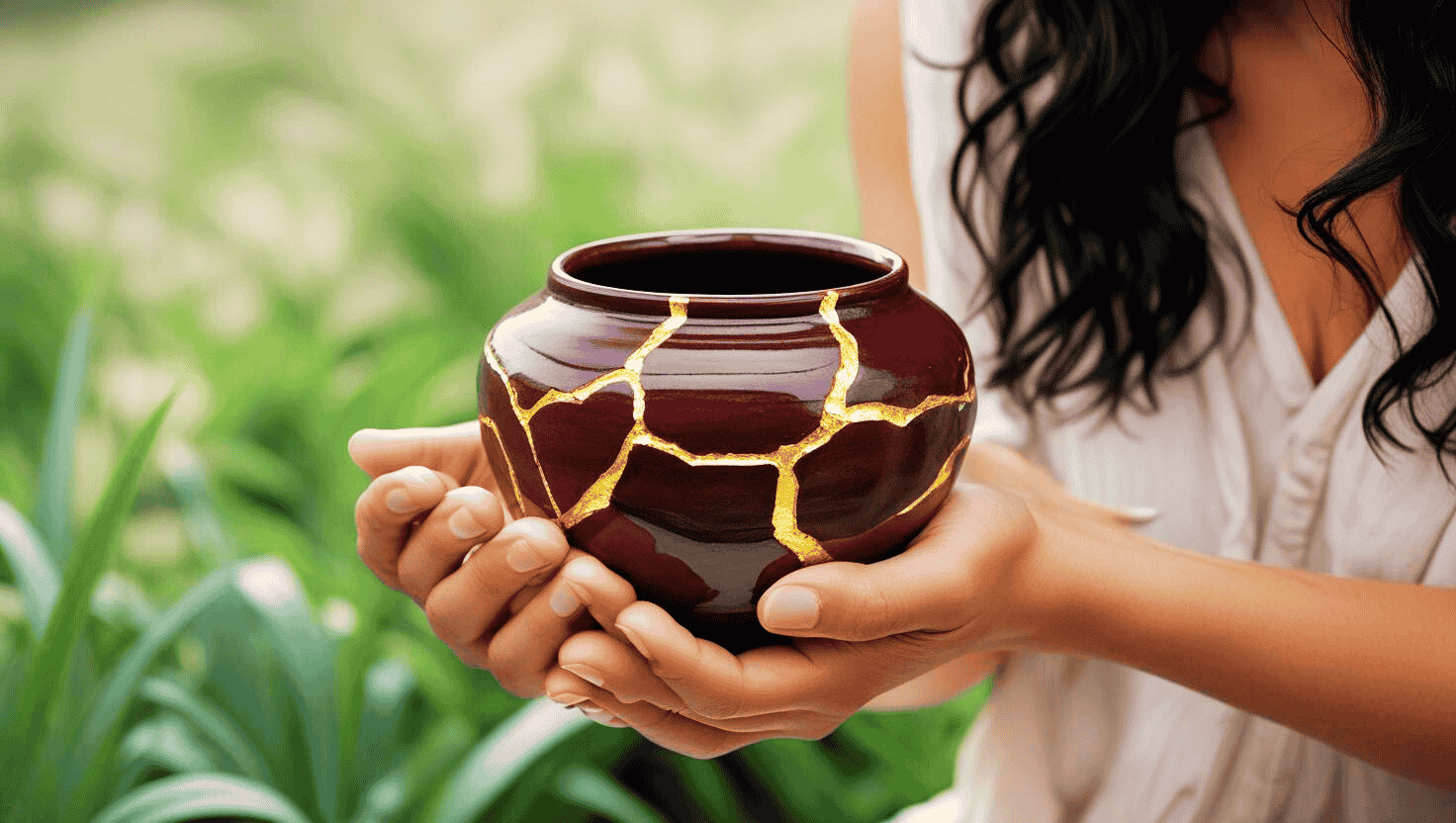
In Japan, there is a 15th-century art called Kintsugi, a term that literally translates to "golden joinery." When a piece of pottery breaks, the craftsmen don’t discard it. They don’t try to hide the cracks or pretend the accident never happened. Instead, they mend the broken fragments with lacquered gold. The piece is transformed into something that is more beautiful and unique than it was before. The cracks aren't hidden; they are highlighted. They become a "Golden Thread" that tells the story of the object’s history, its survival, and its transformation.
At The Golden Thread: therapy for healing, it is our entire philosophy.
The Break is the Beginning
When you first consider therapy for healing, you might feel like you are standing over those shattered pieces of yourself. You might feel exhausted from trying to hold it all together, or confused about how you got here. You might be reeling from past trauma, discouraged based on a history of being invalidated and unheard, or unsure of your own feelings and needs.
The most important thing to know is this: Your experiences don’t diminish you — they make you who you are.
In Kintsugi, the break is the prerequisite for the gold. Without the fracture, there is no place for the repair to shine. Therapy is not about "fixing" you back to a factory-reset version of yourself. You cannot go back to the person you were before you experienced pain, loss, or struggle. And honestly? You shouldn't have to.
The goal of our work together is to find the gold in those cracks. It is to take the history you have lived—the messy, painful, and jagged parts—and weave them into a version of yourself that is stronger, more resilient, and more authentically you. This is the heart of rebuilding self-worth and the work that I do with my clients.
Courage: Picking Up the Pieces
The first step in the journey of transformation is courage. It takes an immense amount of bravery to look at the broken pieces of your life and decide they are worth keeping. It takes courage to admit that the "mask" of perfection isn't working anymore. Many of the people I work with are incredibly high-functioning; they are experts at making sure the outside of the vase looks flawless while the inside is held together by sheer willpower.
Choosing to pick up the pieces and walk into a therapy room is an act of defiance against the idea that you should just "get over it."
In our sessions, courage looks like naming the things that are "not okay," even if they seem small. It looks like voicing needs that you have silenced for years. It looks like fighting "tooth and nail" to reclaim your worth. This part of the process is often the most vulnerable, but it is also where the foundation of safety is built. You get to choose which pieces we look at and when. You are the architect of your own repair.
Curiosity: Understanding the Pattern
Once we have the pieces on the table, we move into Curiosity. In Kintsugi, the craftsman doesn't just slap glue on the edges. They study the break. They look at the way the ceramic shattered to understand how to best join it back together.
In therapy, curiosity is our greatest tool. Instead of asking, "What is wrong with me?" we begin to ask, "What makes me feel this way?". We’ll look at your history, the role you play in different situations, the people in your life, and your triggers.
Some of the challenges I regularly encounter in my practice include:
The Burden of Perfection: That sense that you can’t make a mistake? Perhaps it’s how you learned to stay safe in an environment where mistakes felt dangerous.
The Compulsion to Fix: That feeling of needing to "fix" everyone else? Perhaps it’s a thread of resilience from a time when you had to be the emotional anchor for your family.
The Weight of Hyper-Control: That rigid need for certainty? Perhaps it’s your brain’s way of trying to find safety in an unpredictable world.
The Shield of Ultra-Independence: That reflex of doing things on your own? Perhaps it's a coping mechanism you developed after learning that you could not rely on others.
The Habit of Self-Erasure: That challenge of knowing what you want or need? It is often a habit adapted after having your needs and feelings repeatedly dismissed or invalidated.
When we approach our struggles with curiosity rather than judgment, the shame begins to dissolve. We start to see that our "symptoms" or "problems" were often just survival strategies that we outgrew. We aren't looking for "fault"; we are looking for the Golden Thread— we are making sense of why you are the way you are, recognizing what coping mechanisms no longer serve you, and identifying who you actually want to become based on your values. This shifts the focus from "shame" to self-esteem therapy that actually sticks.
Compassion: Applying the Gold
In the art of Kintsugi, the gold is mixed into a lacquer. Without that adhesive, the gold is just dust. In healing, compassion is that adhesive. But compassion is not just a feeling; it is an action. Most of us are experts at showing kindness to others, but we are brutal toward ourselves. We treat our internal "cracks" with criticism, which only makes the ceramic more brittle.
I fundamentally believe that the same compassion you show to a friend belongs to you, too. Compassion isn't about "letting yourself off the hook" or being passive; it is about providing a safe environment where change is actually possible. You cannot grow in an environment of shame. You can only grow in an environment of warmth and honesty.
In our work, compassion means acknowledging that you have been doing the best you could with the tools you had. It means allowing the "messy work" of change to take as long as it needs to take. It means learning to speak to yourself with a voice that is firm but kind, steady but soft.
When we begin to apply this "gold" to the needs we identified earlier, the repair starts to take shape through small, intentional pivots:
If you carry the Burden of Perfection: Your pivot is to intentionally leave one small thing "unfinished" or imperfect today. Compassion means allowing that mistake to exist without punishing yourself for it.
If you feel the Compulsion to Fix: Your pivot is to practice "compassionate witness." The next time someone you love struggles, try to offer only your presence. Resist the urge to fix, and notice that your value isn't tied to your "solutions."
If you carry the Weight of Hyper-Control: Your pivot is to practice "The Controlled Release." Identify one low-stakes situation this week where you would usually take charge (like the route for a drive or the choice of a movie) and intentionally delegate it to someone else. Notice the "shiver" of anxiety that arises, breathe through it, and allow the outcome to be what it is.
If you wear the Shield of Ultra-Independence: Your pivot is "The Micro-Request." Identify one small task you usually handle alone—something as simple as asking someone to grab you a glass of water or help you carry a heavy bag—and ask for that support. The gold is found in the discomfort of letting someone else hold a piece of your burden.
If you struggle with Self-Erasure: Your pivot is to practice "The Small Choice." When asked for an opinion, instead of saying "I don't care," pause and name one small thing you actually prefer. Reclaiming your voice starts with these tiny golden threads.
Rebuilding Self-Worth: The Goal of the Mending
When we talk about therapy for self-esteem, we are really talking about the structural integrity of your internal world. If you don't believe you are worthy of the gold, you won't ever allow the repair to happen.
Rebuilding self-worth isn't about repeating empty affirmations in the mirror. It is about the "tooth and nail" work of reclaiming your right to exist, your right to have needs, and your right to be imperfect.
In a Kintsugi-inspired repair, the gold doesn't just hold the pieces together; it makes them a cohesive whole. This is the difference between "getting by" and "living seamlessly." When your self-worth is rooted in your resilience rather than your perfection, you become unshakable. You realize that while you didn't choose the "break," you do choose the gold.
Living Seamlessly: The Result of the Repair
What does it look like when the repair is finished?
People often ask if therapy will make the "cracks" go away. The truth is, the events of your life happened. The trauma, the anxiety, the periods of low self-esteem—those are part of your history. But in a Kintsugi life, those cracks stop being "weak points." They become the parts of you that catch the light.
When you live seamlessly, you aren't living "perfectly." You are living authentically.
It looks like recognizing your own value without needing someone else to validate it first.
It looks like setting boundaries to protect your well-being because you finally believe you are worth protecting.
It looks like having a voice in your relationships and realizing that your needs are not an inconvenience.
There is a profound sense of peace that comes from no longer having to hide your history. When you own your worth—golden seams and all—you become a masterpiece of resilience.
Your Invitation to the Journey
I know what it is like to reel from the impact of a "break." I know what it is like to feel confused or unsure of your own feelings. But I also know the incredible, awe-inspiring strength that is found in the mending.
I feel extremely lucky to do this work. I am constantly inspired by the people I work with—their courage to confront deep pain and their commitment to the vulnerable process of transformation. It is truly an honor to bear witness to the entire journey: from struggling to recognize your worth, to committing to the work of change, to finally standing as a whole, authentic person.
If you are standing over your own shattered pieces today, please know that you don't have to pick them up alone. You don’t have to have all the answers, and you don’t have to be "ready" to be perfect. You just have to be open to trying to understand your story with curiosity, courage, and compassion.
The same strength you used to survive the break is the strength we will use to build the repair.
Are you ready to create your golden thread?